In 2023 four ASEAN economies were among the top 15 economies in the world which had trade surpluses with the U.S. – Viet Nam (#4), Thailand (#10), Malaysia (#13) and Indonesia (#14). While all four may be anxious about what awaits them on ‘economic coercion day’ (2nd April 2025), Viet Nam should worry the most. It’s USD 108 billion trade surplus was larger than that of the combined surplus of the other 8 ASEAN economies. Singapore is excluded since it had a USD 10 billion deficit. Of the four ASEAN economies, Viet Nam’s exports to the U.S. grew at the fastest rate – a compound annual growth rate (CAGR) of 15% between 2012 and 2023. In 2023 Viet Nam’s share in US imports was also the highest (6.2%).
It is not clear how reciprocal tariffs rates will be calculated, and it appears that non-tariff barriers and other behind the border barriers may also be considered as the U.S. draws up its coercion measures. The average most favoured nation (MFN) applied tariffs differ from trade-weighted MFN tariffs.
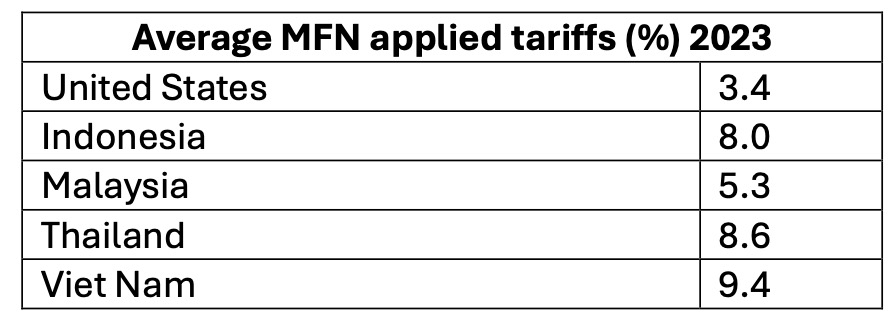
If trade-weighted tariffs are used Thailand should expect the biggest hit, and Indonesia should expect a reduction of one percentage point. Until now the tactics of the U.S. administration have been neither rational nor consistent. Yet the American President has some long-held beliefs, for example, YouTube videos from the 1980s show consistency in his view that that other countries are taking advantage of the U.S. At that time, he singled out Japan and now of course it’s China and maybe also the EU and some other countries. He is right to the extent that the U.S. has absorbed the trade surpluses of many countries but there are benefits as well, such as lower prices and more product variety for American consumers; and the inflow of capital to purchase of US assets including U.S. public debt and equities.

To rectify this, he is using a ‘pay-me-to-play’ strategy. Countries should expect to pay for market access. They can do so by greenfield investment in the U.S., or by reducing their own tariffs to American levels. They could even reduce them to below American levels, which should lead to a reduction in American tariffs applied to their exports. This is why the U.S. Treasury Secretary uses the term “reaction function” when asked about the eventual impact of U.S. tariffs. If other countries drop their tariffs in response, the outcome is welfare enhancing if they don’t, or worse yet, if they choose to retaliate, the escalation can lead to larger welfare losses.
According to WTO rules, tariffs do not have to be reciprocal, since developing countries were granted ‘special and differential treatment’. But the WTO and its rules have not mattered to the U.S. for many years. The appellate body of the WTO has been paralyzed since 2017 when the Obama administration blocked the appointment of judges to the body. The US generalized system of preferences (GSP) which provided duty-free market access to developing countries expired in 2020 and has not been renewed by the U.S. Congress.
The four ASEAN countries therefore have little choice but to deal individually with the ‘world’s best negotiator’. According to various media reports, Viet Nam has already announced some concessions on LNG, automobiles and some agricultural products. The other three could consider making similar moves; cut tariffs or offer to switch from other sources to buying American products where possible. National pride may feel good, but ultimately minimizing economic pain may be a better objective particularly since Indonesia has a serious currency depreciation issue, and Thailand is still struggling to get its tourism sector going again. More importantly, they need to focus on fundamentals: increase productivity and efficiency, particularly in sectors impacted by tariffs and diversify trading relationships.
In the preface to his 2001 book Inevitable Surprises, futurist Peter Schwartz identified the push against globalization as one of four countervailing forces which would work against building prosperity and serving the common interest. This could lead to an “outbreak of protectionism between the United States, Europe and China … and … drive the world into a depression …”. Schwartz referred to America as a “Rogue Superpower” – one that exercises power with few if any constraints and one that need not have an empire so as to avoid the “costs and responsibilities of colonies and subservient states”.
Sources
Schwartz, Peter (2001) Inevitable Surprises: Thinking ahead in a time of turbulence. Gotham Books, New York.
Tariff data: WTO analytical database – 6-digit data for 2023/24 (HS 2002).
Trade data: BACI balanced trade database – 6-digit data for 2023 (HS 2002)
First published on Substack on April 1, 2025.
 asean bagus
Leave a comment