

The Rogue Nation is already here. Five years earlier than Peter Schwartz predicted. The uncertainty which has engulfed the world since Economic Coercion Day will persist for far longer than 90-days. There is only one tool in the toolbox, which is expected to achieve multiple conflicting and unrealistic objectives. Balanced bilateral merchandise trade, bringing manufacturing back to the U.S. and higher foreign investment in U.S. manufacturing. Meanwhile the rest of the world is expected to provide better market access for American firms and products; and continue using the dollar and holding U.S. debt.
The magical tool will continue to be used arbitrarily. Rent-seeking or bargaining by firms and/or industries for exemptions/concessions has started. The American President “helped” Tim Cook recently and may help American car manufacturers next, but the Commerce Secretary says that the exemptions will be temporary.
For the time being we do know that the ‘pay me to play’ tariff rate is 10%. This is the price of market access. We also know, as Singapore’s Prime Minister Lawrence Wong explained so eloquently to Singaporeans – the multilateral trading system no longer exists; the WTO is pretty much dead. Singapore is practically a free port. It also has a free trade agreement with the U.S. In 2023 Singapore had a merchandise trade deficit of about USD 9.3 billion with the U.S. and a current account deficit of about USD 38.4 billion. How is it taking advantage of the U.S.?
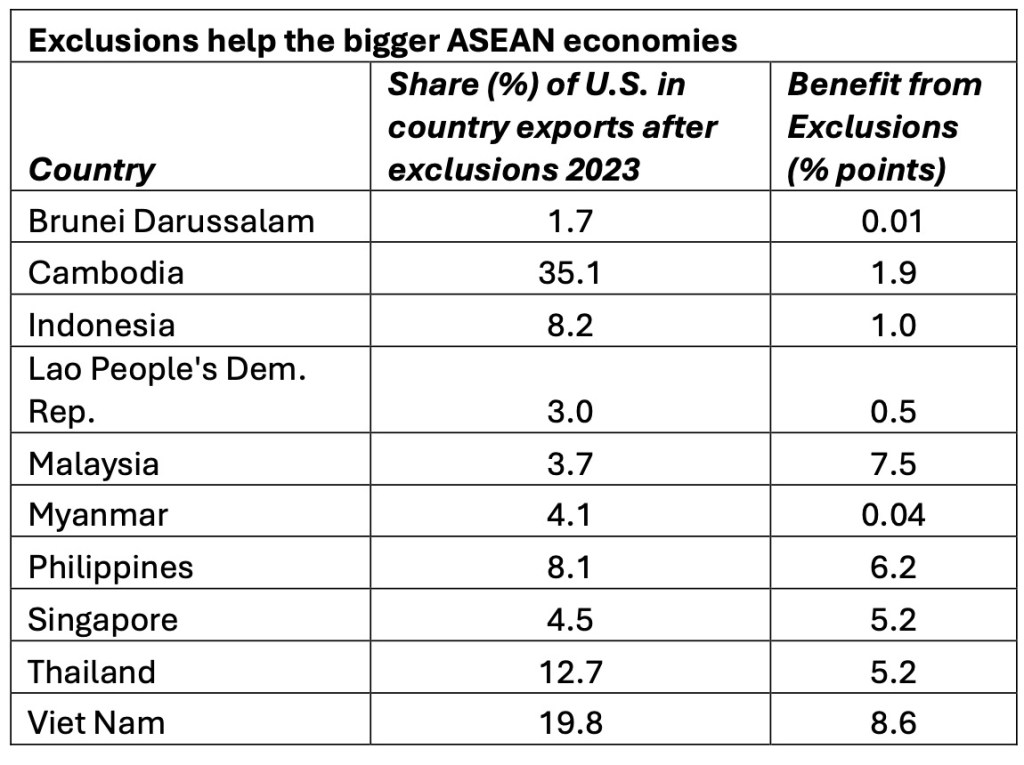
Smaller ASEAN countries such as Cambodia, Laos and Myanmar took a big hit as well. The ‘fake’ tariff calculation formula is a ratio, so its scale invariant. These countries primarily export garments, toys and leather goods. Countries have a 90-day reprieve, and some ASEAN countries have benefitted more than others from exclusions. The initial Executive Order (April 2nd) had some exclusions, and more were added in the April 8th amendment. As a result, a smaller share of ASEAN exports will be exposed to tariffs.
Without exclusions, the share of the U.S. in Singapore’s total exports in 2023 was 9.7%; with exclusions it reduced by 5.2 percentage points, so only 4.5% of Singapore’s exports will be subject to the 10% tariff. But as SM Lee Hsien Loong mentioned in a recent speech “Akan Datang” … pharma tariffs, not to mention the impending ship levies and the impact of declining global trade on the maritime sector in Singapore. Many Singaporean leaders like to use the ‘small boat in a turbulent ocean’ analogy. They forget to mention that the small boat is loaded with containers, making it more difficult to balance and navigate (Singapore’s ration of total merchandise trade to GDP is typically around 1.75 and the ratio of total trade to GDP exceeds 3).
Countries are advised (by U.S. Treasury Secretary) to not retaliate and approach the U.S. with their best offer for bilateral negotiations. Apparently offering zero tariffs is not enough. Before they prepare their best offer, they may wish to read the recent remarks of the Chair of the Council of Economic Advisors before the Hudson Institute. His last suggestion is most intriguing: “… they could simply write checks to Treasury that help us finance global public goods.”
The rest of the world as well as ASEAN face a collective action problem. Every country has an incentive to make a deal, albeit with a ‘Rogue Nation’ that has set aside its existing multilateral commitments. For the longer-term ASEAN countries should adopt a ‘futurist mindset’ to develop national economic strategies and a regional cooperation framework that enhances efficiency and productivity while diversifying trade and investment relationships. The tariffs are likely to remain in place in some form or the other, at least for the next decade.
Sources
Data: BACI balanced trade database HS 2022 (Exemptions list is converted to 6-digit from 8 and 4 digit).
Executive order 14257 April 2, 2025 (Annex 2)
Executive order 14259 April 8, 2025, Amendment
US Customs and Border Protection April 11, 2022: CSMS # 64724565 – UPDATED GUIDANCE – Reciprocal Tariff Exclusion for Specified Products; April 5, 2025 Effective Date.
CEA Chairman Steve Miran Hudson Institute Event Remarks
First published on Substack on April 15, 2025.
 asean bagus
Leave a comment