Technology Classification

Recently, Praveena Bandara along with others, published an informative article in Science on trade in low carbon technology (LCT) goods. They found that emerging market and developing economies, most notably in Africa are left out of trade in LCT goods. To the extent, they do engage, they are net-importers of LCT goods. This along with their lack of resources and existing debt burden; the inability of developed countries to meet their annual climate finance obligations under Paris Agreement; and discriminatory trade policies such as the EU’s carbon border adjustment mechanism will make it difficult for these economies to achieve their sustainability goals.
Another contribution of the article, which is used here, was to classify LCT goods into sectors, and sectors into technology classes. The seven sectors include buildings, energy storage, pollution control, power generation, consumer appliance, transportation, and environmental monitoring. There are twenty-one technology classes. For example, the sector pollution control has three technology classes: air, water and solid-waste. Similarly, power generation includes renewable energy (RE) modular parts, solar, wind, nuclear etc.
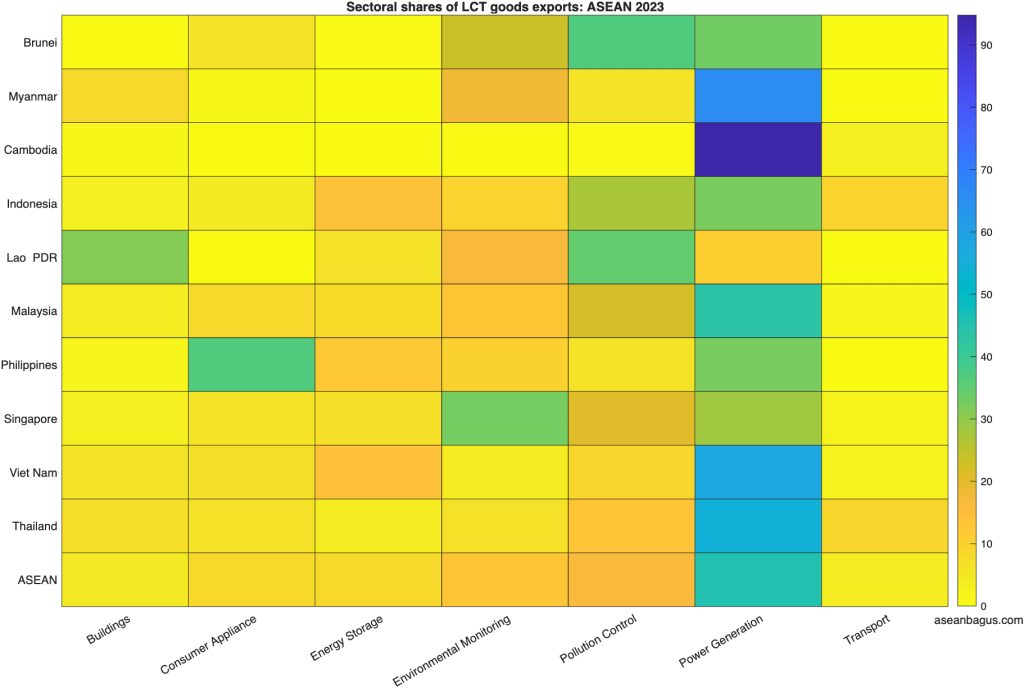
Sectoral shares of ASEANs’ exports of LCT goods in 2023 show that power generation is important sector for all ASEAN countries followed by pollution control. Transport is the least important.
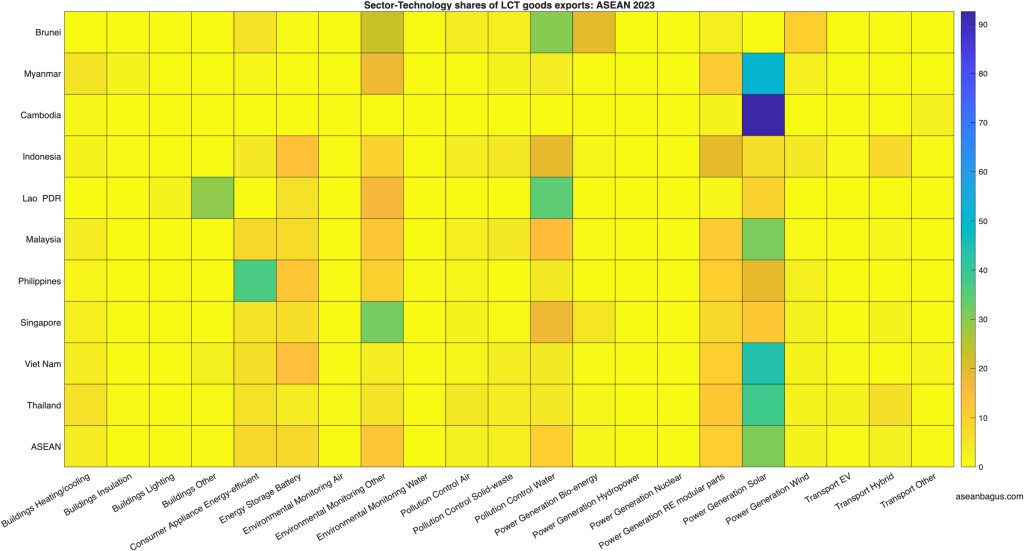
Export shares by technology class provide more detail. They show that within power generation, solar and renewable energy modular parts are important exports and within pollution control, water is most important. Environmental monitoring (other) primarily includes instruments for checking pressure, measuring the flow of liquids and gases and optical instruments. Other technology classes exported by ASEAN economies include energy efficient consumer appliances and batteries for energy storage.
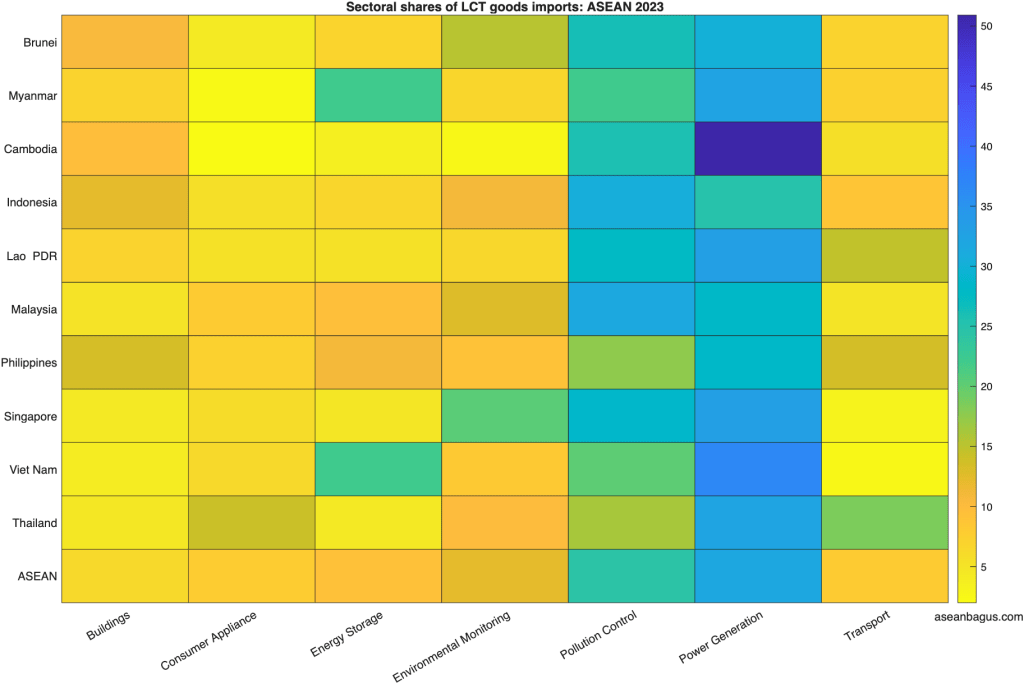
On the import side, power generation and pollution control are most important, followed by environmental monitoring and transport.
The technology class of imports shows that ASEAN imports solar and wind products and renewable energy modular parts. It imports all three types of pollution control equipment including air, water and solid-waste. And ii imports energy efficient consumer appliances, hybrid & electric vehicles, and batteries for energy storage.
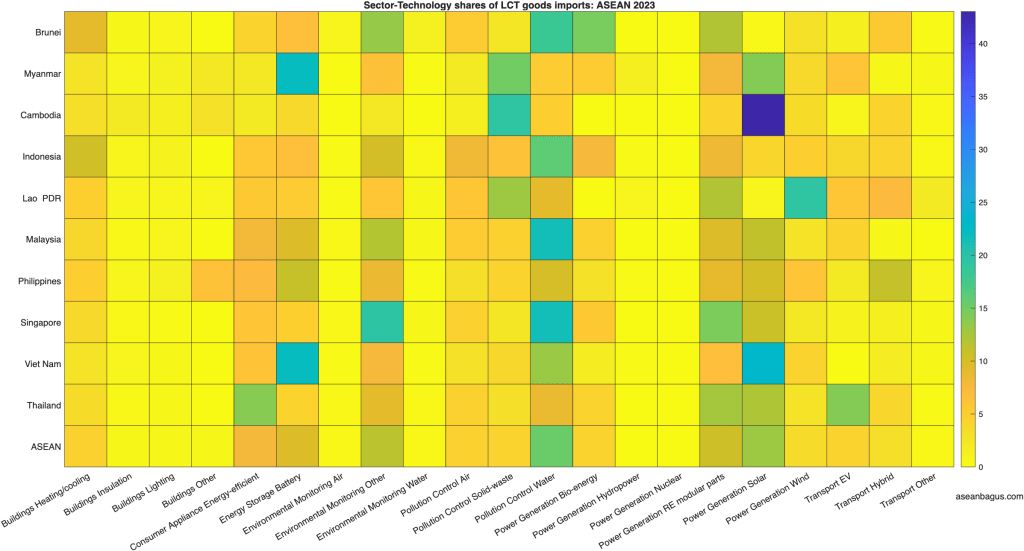
Since some sectors/technology classes are important in both exports and imports, this indicates intra-industry trade. As an earlier post showed, ASEAN imports are primarily from Asia and from China in particular, export destinations are more diverse, but the U.S. is the main destination. It is this type of trade that that the ‘transhipment’ tariffs imposed by the U.S. are directed at. Regardless of whether these products are just trans-shipped or there is considerable domestic value added in ASEAN, the U.S. should not really care since the American future is about coal, oil and gas. According to the American President, investments in renewable energy are a waste of money because climate change is a hoax.
Sources:
BACI balanced trade database (HS 2017).
Bandara P, Ray R, Lu J, Gallagher KP. Developing countries locked out of low-carbon technology trade. Science. 2025 Apr 18; 388(6744):248-250.
 asean bagus
Leave a comment