What are environmental goods/products or green goods? The answer is, nobody knows, and new lists keep emerging every other year. They have been compiled over the years for various reasons such as increasing trade and investment and tariff reduction. They are likely to continue to evolve with changes in technology. Here is what is available, and it is probably not comprehensive.
WTO: A comprehensive reference list of 408 products and a sample core list of 26 products. (WTO 2011)
PEGS: (an OECD list for a plurilateral environmental goods and services agreement) list of 165 products
‘Friends’ of WTO: list of 154 products
APEC: list (for tariff reduction) of 54 products
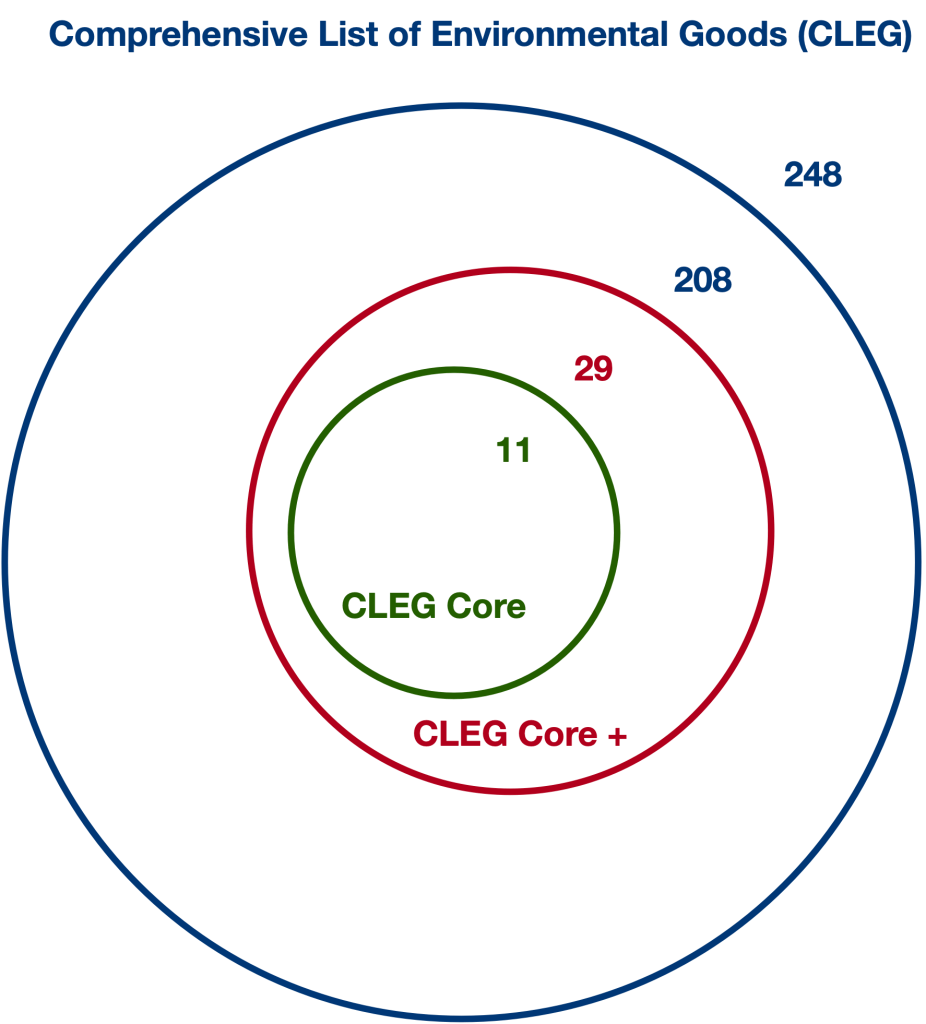
CLEG: Combined list of environmental goods, which is the union of the previous three lists and includes 248 products.

CLEG has two subsets: Core CLEG + (40 products) and Core CLEG (11 products). These two lists were selected with ‘expert’ advice from a consulting firm.
A useful starting point is a 2014 OECD paper which provides background as well as a listing (HS 2007) of all the products included in the various lists described above.
Products in the CLEG list are divided into the following categories or classes:
- Air pollution control
- Cleaner or more resource efficient technologies and products
- Environmentally preferable products based on end use or disposal
- characteristics
- Heat and energy management
- Environmental monitoring, analysis and assessment equipment
- Natural resources protection
- Noise and vibration abatement
- Renewable energy plant
- Management of solid and hazardous waste and recycling systems
- Clean up or remediation of soil and water
- Waste water management and potable water treatment
More recently the IMF came up with two more lists:
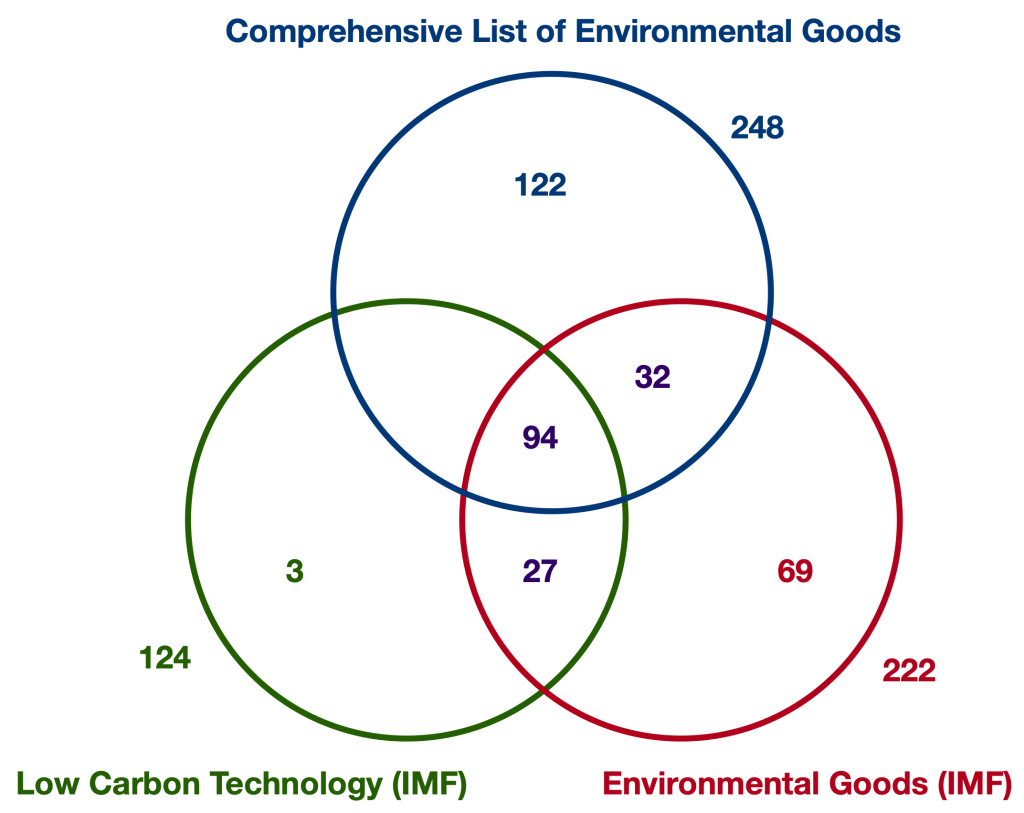
ENV: list of 222 environmental goods, defined as goods connected to environmental protection (such as catalytic converters for vehicles, trash bags, rubbish containers) and goods that have been adapted to be cleaner or more environmentally friendly (such as mercury-free batteries and hybrid and electric cars).
LCT: list of 124 low carbon technology products defined as products that are less polluting than their traditional energy counterparts. These products are important for transition to a low carbon economy (such as wind turbines, solar panels and carbon capture equipment).
Environmental goods relate to environmental protection and management, where as LCT goods include products which reduce greenhouse gas emissions or are less polluting. These goods may be less carbon intensive in their use, but not necessarily in their production.
WTO-RE: A list 35 of renewable energy products (solar, wind, hydro, green hydrogen and biofuels). (WTO 2024)
And there are more. A number of trade agreements have lists of environmental/green goods. They include the UK-NZ FTA (293 products); the EU-NZ FTA lists about 47 environmental products and roughly 35 environmental services. The Agreement on Climate Change, Trade and Sustainability (ACCTS) was signed in 2024 between NZ, Iceland, Costa Rica and Switzerland. Chapter 2 (Annex 2) lists about 360 environmental goods. Finally, the Singapore-Australia Green Economy Agreement of 2022 lists over 370 environmental goods.
Enough to drive you crazy? Perhaps better to ignore history, make up your own or stick with the IMF lists of environmental and low carbon technology goods.
Sources
WTO 2011: WTO Report by the Chairman to the Trade Negotiations Committee on the Committee and Trade and Environment in Special Session TN/TE/20 (21 April 2011) (HS 2002)
WTO 2024: Addendum, Statement by co-convenors of TESSD, MC, 13th Session, Abu Dhabi, WT/MIN(24)/11/Add.3 (HS 2022)
OECD 2014: Sauvage, J. (2014): The Stringency of Environmental Regulations and Trade in Environmental Goods, OECD Trade and Environment Working Papers, No 2014/3. (This paper provides the CLEG and other lists in HS 2007 (H3). See OECD 2019 for conversion to other HS versions HS 1992 (H0) to HS 2017 (H5)).
OECD 2019: Garsous, G. (2019) Trends in Policy Indicators on Trade and Environment, OECD Trade and Environment Working Papers, No 2019/01
IMF: Details of both ENV and LCT (HS 2017) are available at the IMF Climate Change Indictors Dashboard. The LCT list (spreadsheet) can be downloaded, but for some reason, the EVN list is no longer available for download. Fortunately, I got a hold of it before they removed the file. I wrote to them to request that they put it back, but they did not.
IMF Book: Data for a Greener World (2023) Chapter 9 discusses LCT goods.
UK-NZ FTA (2022): Annex 22-A – List of environmental goods.
EU-NZ FTA (2023): Annex-19 – List of environmental goods and services.
ACCTS (2024): Annex II – List of environmental goods.
Singapore-Australia (2022): Annex B1.1– List of environmental goods.
 asean bagus
Leave a reply to ASEAN Green Competitiveness Index – asean bagus Cancel reply