I am entropied out. But before year’s end I thought I would apply Teza’s method to visualize trade diversity for ASEAN economies. How concentrated are your trading relationships? This appears to be becoming an issue for many countries for various reasons. For ASEAN economic coercion from the United States is the main reason for looking for alternative markets in South America and Africa.
In the meantime, some ASEAN member states such Malaysia and Cambodia have signed what can best be described as ‘unequal treaties’ with the U.S. The text of the deal with Malaysia indicates that the U.S. will charge a 19% tariff on Malaysian goods but Malaysia will open up its markets to the U.S., particularly for digital and technology trade; it will not impose a digital services tax on American firms; it will consult with the U.S. before signing a digital trade agreement with a third country; and if the U.S. imposes trade restrictions on a third country to protect its economic or national security, Malaysia “ shall adopt or maintain a measure with equivalent restrictive effect …” on the third country (Article 5.1). The U.S. also retains the right to impose higher tariffs on Malaysia if Malaysia signs a trade agreement “with a country that jeopardizes essential U.S. interests” (Article 5.3). Many of these clauses have invited criticism from domestic political parties.
In the following figures, total trade (exports+imports) in billions of USD is measured on the vertical axis, The horizontal axis constructs a measure of entropy using trade partner shares in a country’s trade as weights. This is then run through Teza’s fixed-point (re-weighting) algorithm, rewarding trade with countries which are more diversified and penalizing trade with countries which have more concentrated trade relationships. The spearman rank correlation between the ‘raw’ and ‘optimized’ Shannon entropy index is 0.923. The colour bar shows the number of trading partners in 2023. The following figure shows over 200 economies, only some of them are labelled. The top-right is the best place to be. Small-island developing nations lie closer to the origin. Lao PDR (land-locked) and Timor-Leste have the lowest entropy, and the four ASEAN economies Indonesia, Malaysia, Singapore and Thailand are clustered towards the top right. Both Viet Nam and the Philippines had fewer trading partners in 2023 than the four ASEAN economies mentioned earlier. [Please open all images in new tabs]
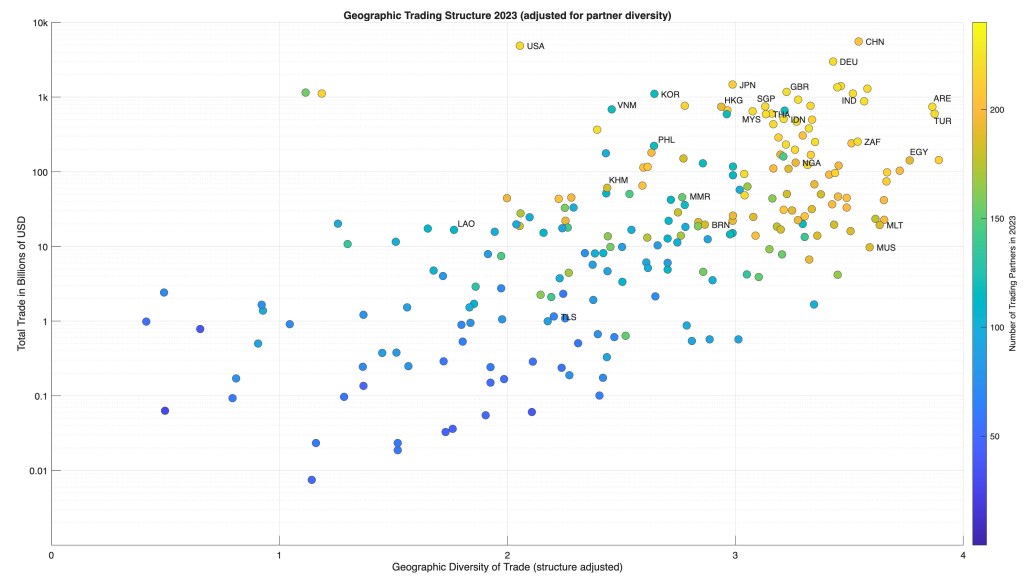
The two dots to the left of the U.S. are Canada and Mexico and due to their trade agreement with the U.S., they rely on the latter for an overwhelming majority of their trade and investment. In fact their dependence increased during what is now referred to as the age of ‘hyper globalisation’. The agreement is up for re-negotiation in 2026, and in preparation, Mexico has buckled or started appeasement, by imposing tariffs directed at Asian economies with which it does not have an FTA. These are of directed primarily at China, but economies like India, South Korea and some ASEAN economies will also be affected. Mexico, Brunei, Malaysia, Singapore and Vietnam are all members of the CPTPP.
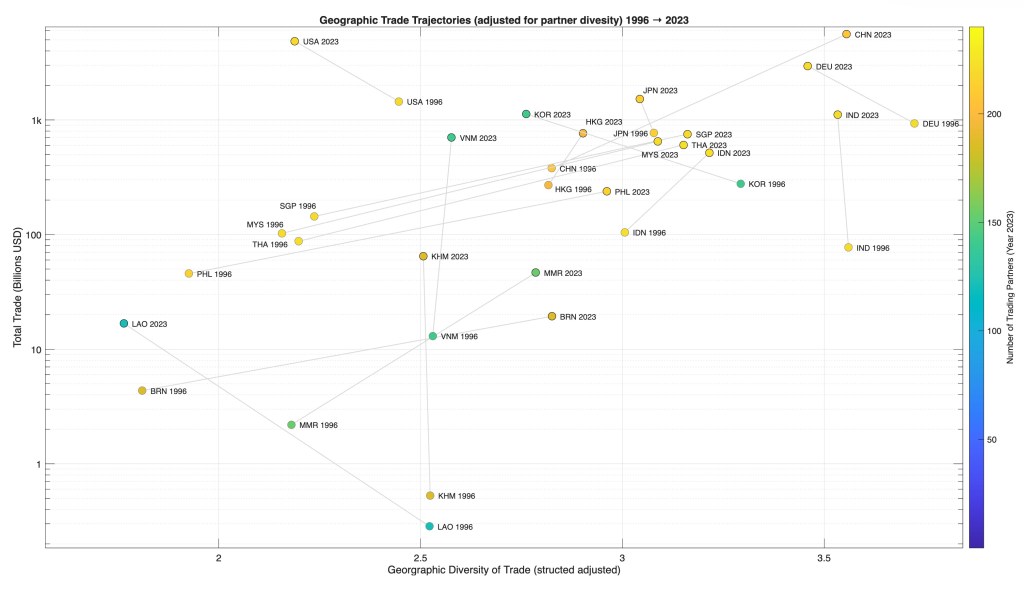
The following figure shows the geographic trade trajectories (between 1996 and 2023) of selected economies. With the exception of Lao PDR (and marginally Cambodia) all ASEAN economies substantially increased the diversity of their trading relationships (and traded more with more diverse economies) – Viet Nam did so only marginally, making primarily a vertical move, or increasing total trade. Many mature economies (U.S., Germany, Japan, South Korea) moved toward more concentration.
In 2026, ASEAN should continue on the path of open regionalism (and resist signing unequal treaties). Many other economies of the world, particularly in the West are turning inward – more restrictions on the movement of people (even though they have demographic issues), more trade and investment barriers (particularly on the most efficient producers) – meaning buying from less efficient producers, or worse, higher deficits to support domestic (uncompetitive) firms and in some instances using buy-domestic mandates or government procurement to buy from domestic producers. This will lead to higher prices, and the domestic population gets hit twice, first to use public money to subsidise domestic industry (higher deficits now and higher taxes in the future) and second, to use public money to buy high priced products from these uncompetitive firms (higher deficits now and higher taxes in the future). It’s a no-win situation. Instead, countries should use this opportunity to think hard and facilitate structural change. But a long-term view and structural adjustment policies (supply-side polices), such as education, skills development and training or re-training are not as prevalent as they need to be in many Western economies – they prefer to hand out money to ‘save jobs’ – and in many instances those jobs disappear anyways. The folly of this inward-looking approach will become apparent sooner rather than later. We already have entered or are about to enter what I think of as the ‘age of consequences’. The last five years (since Covid) have laid the world bare – the good and the bad, or as Warren Buffet puts it (roughly) “When the tide has gone out, we know who is swimming naked”. The tide has gone out; we know who is swimming naked. The consequences are coming. Happy New Year!
Notes
2023 figure uses HS 2022 data
1996 and 2023 figure uses HS 1996 data
Sources
Agreement Between the United States of America and Malaysia on Reciprocal Trade, The White House, October 26, 2025.
Joint Statement on United States – Malaysia Agreement on Reciprocal Trade, The White House, October 26, 2025.
Trade data are from the BACII balanced trade database (HS 2022 (6-digit)).
Teza, G., Caraglio, M. & Stella, A.L., Entropic measure unveils country competitiveness and product specialization in the World trade web. Sci Rep 11, 10189 (2021).


Leave a Reply