The ‘oil price shock’ resulting from the illegal war on Iran has resulted in cost-push inflation. In many economies it is a stagflationary shock from the outset, due to shortages not just of oil and gas, but of packaging materials (which use petrochemicals), fertilizer and aluminum. In some ASEAN economies, prices have risen and there are shortages (supply shock) as well. Think of the farmer in Thailand who cannot harvest their crop because of a shortage of diesel or one who intends to use less fertilizer because of high prices; the yield will be lower so food supply will decline and prices will increase sometime in the future.
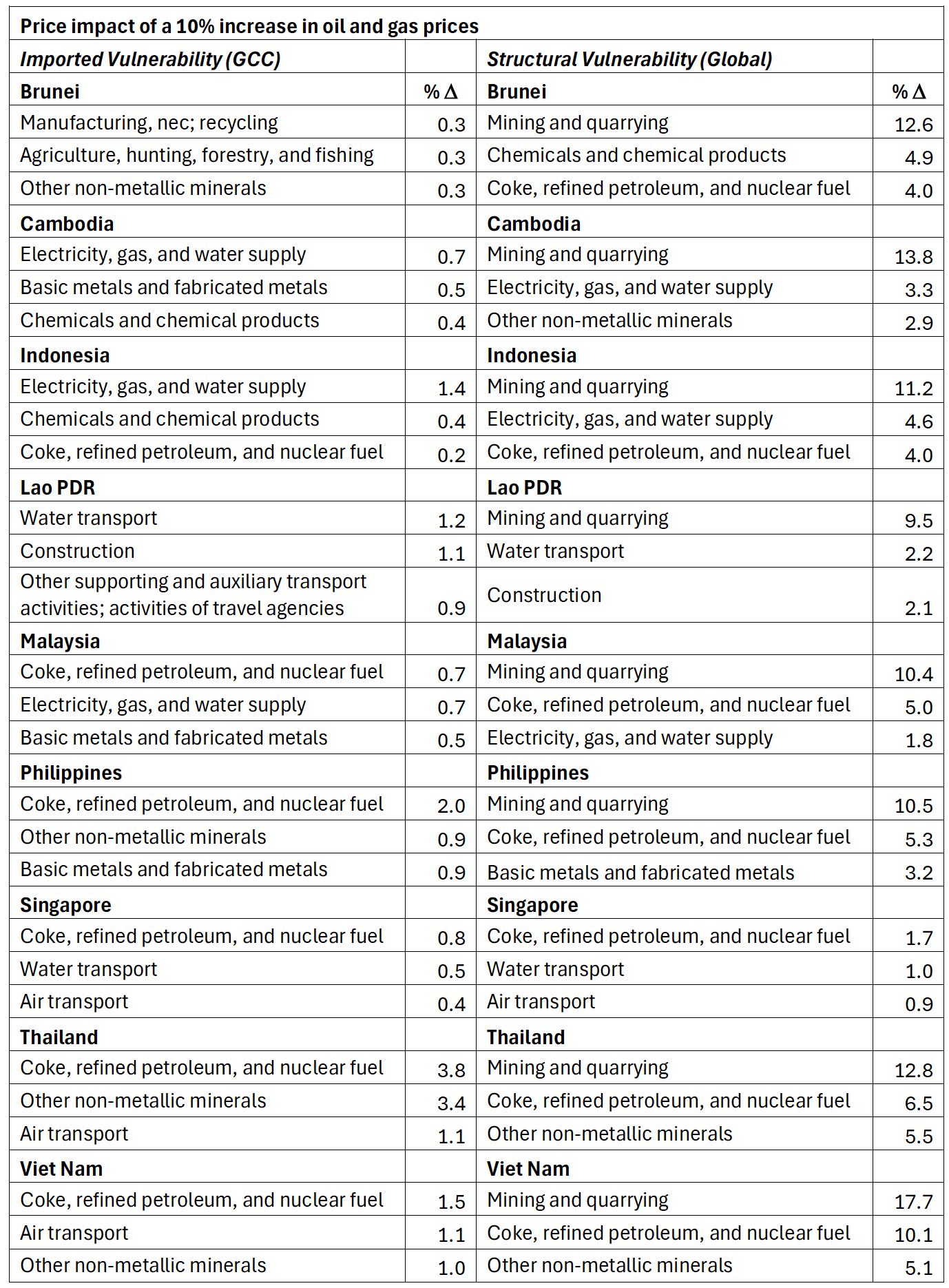
I provide rough estimates of the inflationary impact on ASEAN economies and also list the industries whose output prices are impacted the most (top 3). The limitations of the estimates are described in the notes and are due to the limitations of the ADB-MRIO (multi-regional input-output) tables. I use these because both constant and current price tables are available for the year 2024 (most recent available).
Price changes in ASEAN and ASEAN industries reflect changes in factory gate prices. They are not producer prices which typically include taxes, wholesaler margins and transportation.
Two cases are considered. A 10% increase in the cost/price of GCC oil and gas and a 10% increase in cost/price of global oil and gas. The latter is perhaps more realistic since oil is commodity.
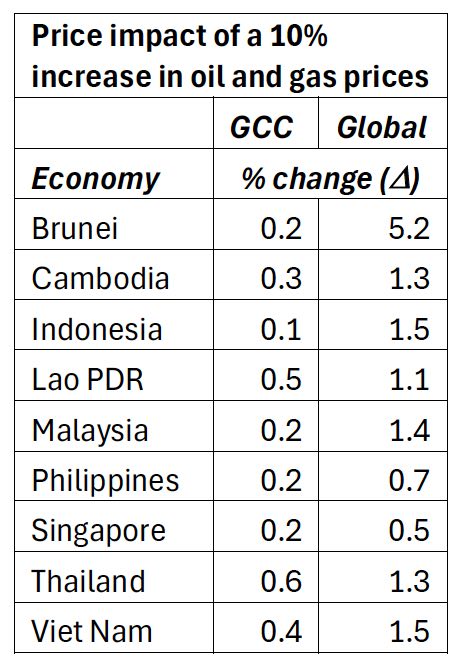
In the following table, imported vulnerability refers to the transmission of a price shock driven by import dependence on a specific source (GCC) whereas the structural vulnerability reflects the intrinsic price sensitivity to (crude) oil and gas regardless of the source (global). The latter captures the present predicament more realistically since oil and gas prices have risen across the board, regardless of the source, and in fact the magnitude is more than the 10% increase assumed here. Since the input-output system is linear, it scales. This means that if you think oil and gas prices increased by 40% instead of 10%, you can quadruple the price changes reported in both tables.
Notes
Both constant and current price versions of the input-output tables are required to implement a cost-push (price) shock. OECD-ICIO (inter-country input-output) tables are in current prices. The ADB-MRIO (multi-regional input-output) tables are available for the year 2024 at both current and constant (2010) prices. I use the ADB tables for this exercise.
Why are these rough estimates? Because the ADB tables have two limitations. First, they have 62 countries and the rest of the world (ROW). None of the GCC countries are included in the 62 countries, although other sources of oil and gas such as Australia, Russia, USA, and Kazakhstan are included. Latin American, African, GCC countries and others are all aggregated as ROW (rest of the world). In the GCC price shock, I use ROW, which is an overestimate since it also includes African producers such as Nigeria and Angola, which export to some ASEAN economies, although these are not major sources.
The second limitation is that the ADB tables have fewer sectors (35) compared to the OECD ICIO tables. Instead of Extraction of crude petroleum and natural gas, they have a sector called Mining and Quarrying. This is the sector I use as a proxy. According to ISIC (International Standard Industrial Classification) version 4, Mining and Quarrying includes the following five sectors: mining of coal and lignite; extraction of crude petroleum and natural gas; mining of metal ores; other mining and quarrying; and mining support service activities.
By using the ADB tables, I am overestimating production by GCC economies and overestimating production of crude petroleum and gas.
- The GCC price shock uses: Mining and Quarrying for ROW.
- The global price shock uses Mining and Quarrying for all countries (including ROW) in the ADB tables.
ASEAN economy-wide price changes (the first table) are a weighted average. Weights are industry/sector shares in gross output.
ADB tables do not include Myanmar and Timor-Leste.
Sources
ADB (2025): MRIO


Leave a Reply