In September this year, two sets of medals were handed out. The first at the 20th Asian Games in Aichi-Nagoya, came amid controversy: an inadequate budget, poor accommodation, widespread transport and logistical failures and, not least, the North Korean national anthem being played at a men’s hockey match between Bangladesh and South Korea. Surprisingly ‘un-Japanese’, at least in my experience of Japan. Those winners were celebrated on their return home, with TV interviews for some and perhaps product endorsement deals for others.
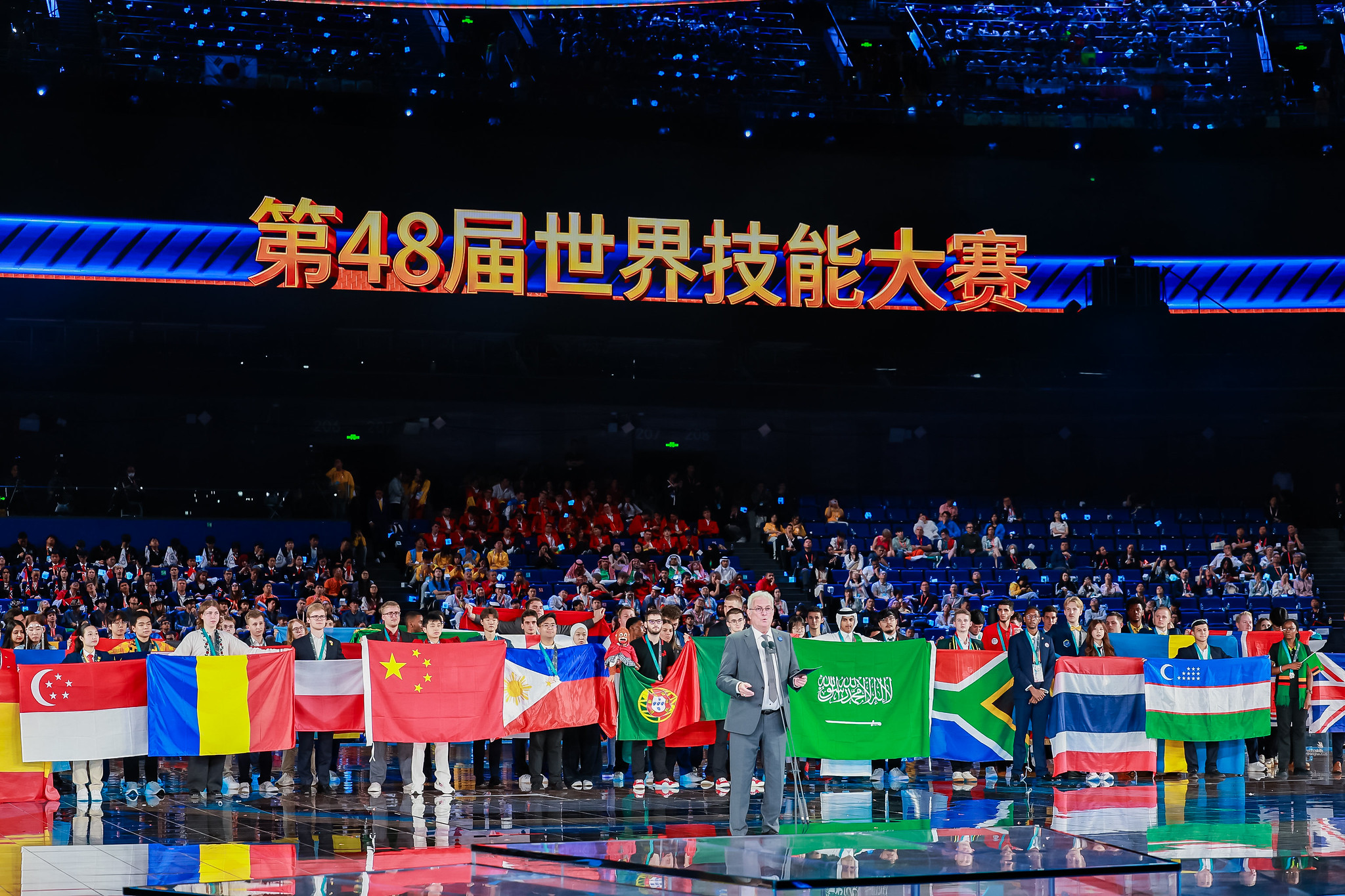
Had it not been for an article in The Straits Times, I would never have found out about the second set of medals. The second set of medals (and ‘Medallions for Excellence’) were handed out at the 48th WorldSkills competition in Shanghai. I am sure the winners at this competition were celebrated as well, but perhaps amongst a smaller circle.
Both were competitions, so they may have many things in common, such as China topping both competitions, but there are two important differences. At the Asian Games, participants competed against each other, either individually or in a team and medals were awarded to the top three. At WorldSkills participants were assessed by ‘experts’ and competed against a standard or what WorldSkills calls a “norm”. Medals were awarded to the top three and medallions were awarded to any participant who exceeded the norm or (since 2017) obtained a score greater than or equal to the median score of 700 (Prior to 2017 the ‘norm’ was set at an average/mean score of 500. Depending on the competition year, the median was roughly between 503 and 506). So, any participant who scored at or above the norm (in any event or skills competition) went home with an award (medal or medallion).
WorldSkills is a charitable organization which has been around since the 1950s and holds competitions roughly every two years. Of course, initially most of the participants were from Western countries, but over time other countries have joined and WorldSkills now has roughly 90 national and/or regional members representing roughly two-thirds of the world’s population. Sixty-five countries participated in sixty-four events (types of skills) in 2026.
According to the WorldSkills website, Malaysia was the first ASEAN country to become a member in 1992. It was followed by Singapore and Thailand in 1993, and the Philippines in 1994. Brunei joined in 2004, followed by Indonesia in 2005 and Vietnam in 2006. With the exception of Brunei and the Philippines, ASEAN countries have been regular participants in competitions since joining. Brunei entered three events for the first time in 2026 and did not win any awards. The Philippines was absent from competitions between 2005 and 2015. The remaining ASEAN economies are not yet members and I am not sure why. Surely, they must have someone who is an excellent florist, hairdresser, cook, baker, or welder?
WorldSkills focuses on TVET/VET (Technical and Vocational Education and Training) skills. Over the years the organization has worked with various experts and international organizations to refine and improve the competitions and to ensure unbiased assessments. Presently, it develops occupational descriptions, standards and assessments. It is co-operating with the OECD, which is developing a PISA-VET assessment (similar to PISA, but for vocational skills). The set of skills included in WorldSkills competitions is refined on an ongoing basis and reflects skills which are in demand.
The WorldSkills competition allows members flexibility to participate in as many events as they want and to set whatever goals they want to set for themselves. Some may enter to win, others to learn, to motivate and engage their youth, to benchmark their performance or monitor national TVET outcomes. In 2026, Brazil and China participated in all 64 events and India participated in 63. Portugal, on the other hand, only participated in seven events and won one silver medal and six medallions – every participant won an award. Some members choose to focus on newer skills such as cyber security, digital construction and renewable energy, whereas others choose to focus on more conventional skills which account for most of the employment in their country.
ASEAN
ASEAN’s performance is shown in the following figure.
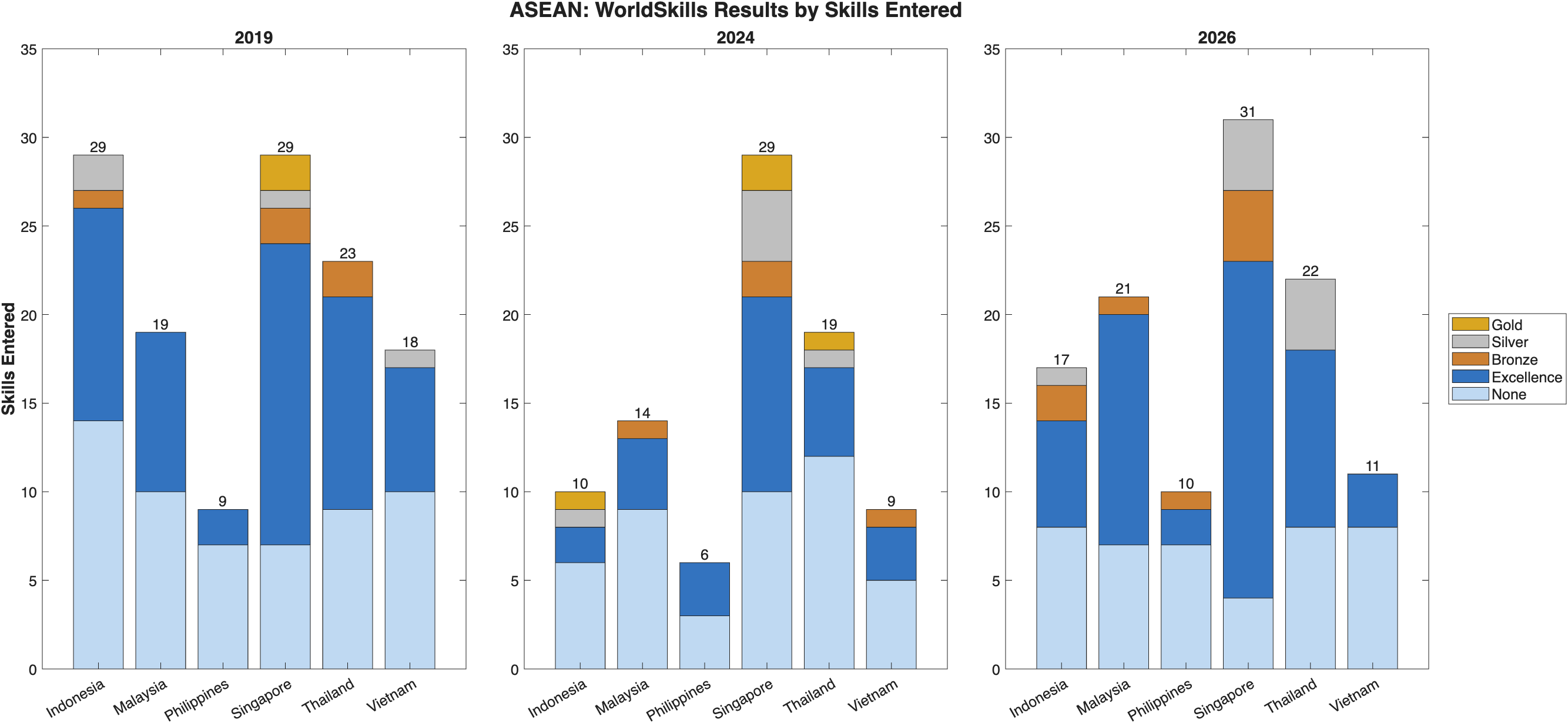
The number of events these ASEAN countries have participated in and their awards appears to vary from one competition to the next, but whether the award count and type of award is the appropriate measure of performance depends on the country itself. Singapore did not win any gold medals in 2026, but that does not necessarily mean it did not do as well as it did in previous years. With the exception of 1997 the average score of all Singapore participants (across all events/skills Singapore participated in) – the national average score – was above the WorldSkills competition norm. This means that, on average, Singapore performed above the standard or norm, regardless of the number of awards. The same cannot be said for other ASEAN participants. The average score of Indonesia (2024), Malaysia (2026), Philippines (2017) and Vietnam (2017) exceed the competition norm only in the year indicated in parentheses above. Thailand’s average performance exceeded the norm in ten of fifteen competitions for which data are available.
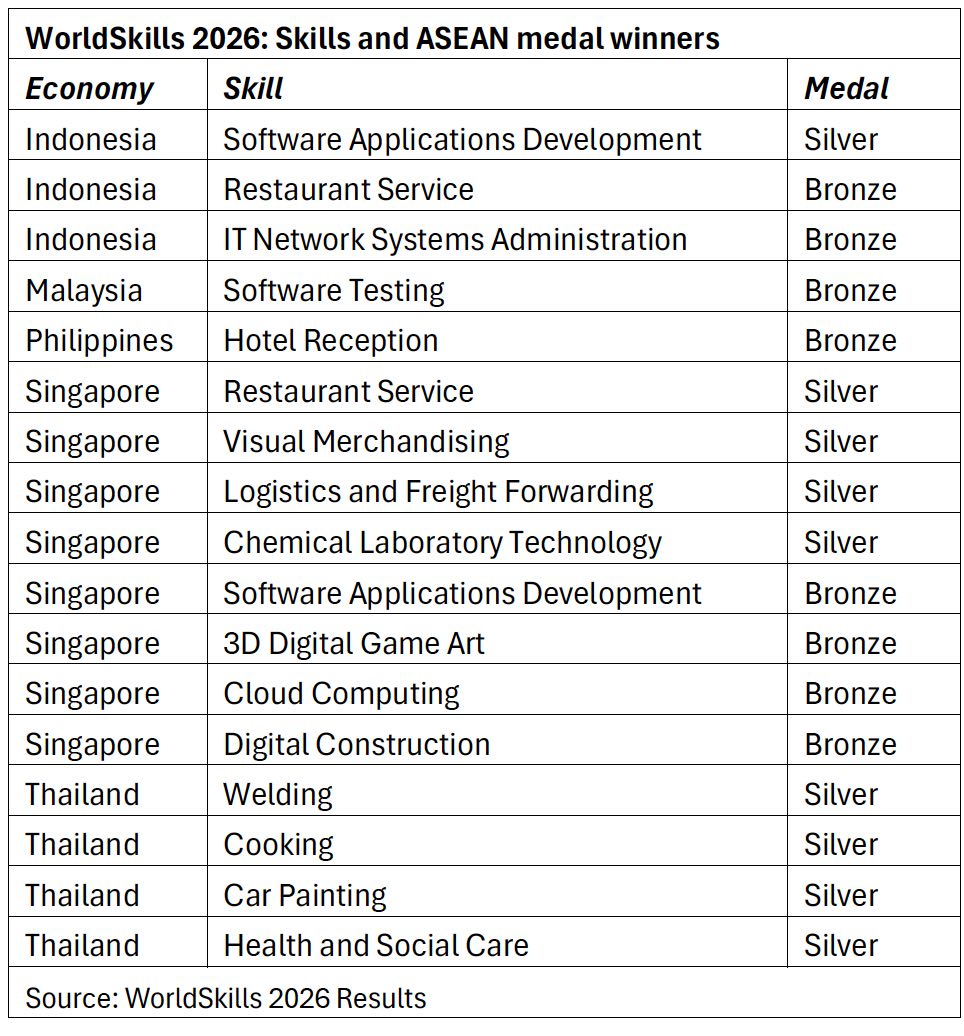
The following table shows the skills in which ASEAN countries won medals in 2026.
Beyond benchmarking & China’s experience
A report was also released at WorldSkills 2026 that discusses China’s experience at WorldSkills and how it has been quite effective in moving beyond benchmarking to incorporating its experience in the broader TVET system in the country. Attending competitions allows countries to benchmark their skills relative to standards or norms and it facilitates learning between participants and countries. The real work starts after that.
China first competed in 2011 in 6 events/skills and by 2019 it was competing in all available skills. It went from winning one silver medal in 2011 to leading the awards count since 2017 (with the exception of 2022 where the competition was held at different locations due to the pandemic). In the early years (2011-15) its focus was on orientation, learning and institutional development. From 2016 onwards (13th five-year plan) the focus shifted to using the WorldSkills experience and system for national TVET reform.
The link between the competition and the TVET system, or the ‘glue’ that holds the two together are the ‘experts’ who assess participants. There are also trainers who train participants. Each member country can appoint one expert per skill competition entry. On average, 40% of the experts change with every competition cycle. Like Switzerland, experts from China had a very low turnover. This provides stability but also allows them to build knowledge over numerous competition cycles. Chinese experts were highly qualified and were drawn from 23 locations, although many came from Beijing (10), Shanghai (13), Guangzhou (9) and Chongqing/Anhui/Nanjing (5 each).
The knowledge accumulated by experts, trainers and mentors was transferred in a systematic way to the wider skills system. They contribute to curriculum development, developing training methodologies and assessment and teacher training and development. In addition, experts need to interact with business in order to understand emerging skills and modern equipment requirements. China has been successful due to consistent and sustained long-term policy commitment and support. There is co-ordinated action across ministries, government agencies, industries and training institutions. Industries and training institutes collaborate in program design, curriculum development, staffing, facilities with modern equipment and quality assurance. Industries also provide technical specialists and workplace learning opportunities. China is a large country and it will take some time to ensure that there is broader access to high-quality training resources and expert support.
Integrating WorldSkills standards and methodologies with the national TVET system in itself is a huge task and one that requires consistent long-term commitment and continuous upgrading. But there are two other potential barriers. The first is a huge social barrier. In many societies, people who work primarily with their brains have higher social status than people who work primarily with their hands. The second relates to the legacy educational system. Some countries (such as India) may have overinvested in universities and underinvested in TVET. Double-digit youth unemployment is a global problem and some of this may be attributed to a skills mismatch. Countries may have to re-assess or change their educational systems and/or re-direct new public funding towards TVET.
Strong performers in TVET such as Singapore and Switzerland already have a system in place. Singapore as the ‘differentiated pathways’ system which accommodates student interests, potential and performance and directs some students to Polytechnics and the Institute of Technical Education (ITE). These students can enter university at a later date if they wish to. Switzerland has a ‘dual’ education system which seeks to blend theoretical and practical knowledge simultaneously. As the Director of Education and Skills at the OECD wrote in the foreword to the WorldSkills Report: TVET “hinges on an effective integration of the world of learning with the world of work”. This may be a relevant and important insight for university education as well.
The ASEAN countries which are not yet members of WorldSkills need to seriously consider technical and vocational training. The platforms already exist. Not only is there WorldSkills, but there are also regional versions such as WorldSkills ASEAN and WorldSkills Asia. Even ASEAN has a TVET Council, although the focus appears to be on newer (4th industrial revolution) skills. They need to start taking advantage of these platforms and then get down to the hard work of integrating the standards and methodologies into their TVET systems.
The 49th competition in 2028 will take place in Aichi. I hope the Japanese can get their act together this time.
Sources
Image: WorldSkills Flickr.
The Straits Times, “Singapore wins four silvers, four bronzes at WorldSkills Shanghai”. September 28, 2026.
WorldSkills Report 2026: In pursuit of skills excellence


Leave a Reply