Signing trade agreements entails a lot of fanfare. Usually around access to a large market and the potential impact on GDP of signatory economies. That is just the first step. The difficult work, which gets much less attention from both policymakers and economists comes afterwards. Beyond market access, exporters need to worry about production capacity, supply chain issues and technical aspects such as product safety, packaging and labelling. It’s often due to these ‘trade facilitation’ issues that some trade agreements remain underutilized.
ASEAN economies have very little in common but most South-east Asians consider durian to be the ‘King’ of fruit. A fruit that usually evokes an extreme reaction from the uninitiated. For them, it is either fragrant and delicious or it stinks and tastes awful. The aroma is strong and that’s why in many ASEAN countries it is not allowed on public transport, in hotels and shopping malls. You have to enjoy it either out in the open or at home. Durian has strong cultural roots as well (Sean Wang Zi-Ming). The Malay word for an unexpected windfall is to get a falling/fallen durian – durian runtuh. Vancouver-based novelist Larissa Lai has a character (Miranda) in her novel Salt Fish Girl who smells of durian.
Durian trees can take anywhere from four to seven years to mature and there are hundreds of varieties with different price points. Tastes vary but Malaysian durians (Musang King, Black Thorn) are usually considered to be at the top end since they are ripened on the tree and Malaysian producers are ambivalent about abandoning this practice even though it reduces the shelf life as they are ideally consumed within 48 hours of harvest. Thai Monthong and Chanee varieties are also sought after and are harvested before they are ripe. Vietnam is a high-volume exporter but product quality varies. The Chinese market is critical for Thailand as Thailand exports roughly 75% of its production and China accounts for about 97% of Thai durian exports. In 2026, durians accounted for about 48% of Vietnam’s fruit and vegetable exports to China (VN Express International). Malaysia’s durian market is primarily domestic although it is trying to increase exports to China, particularly if there is a glut in the domestic market.
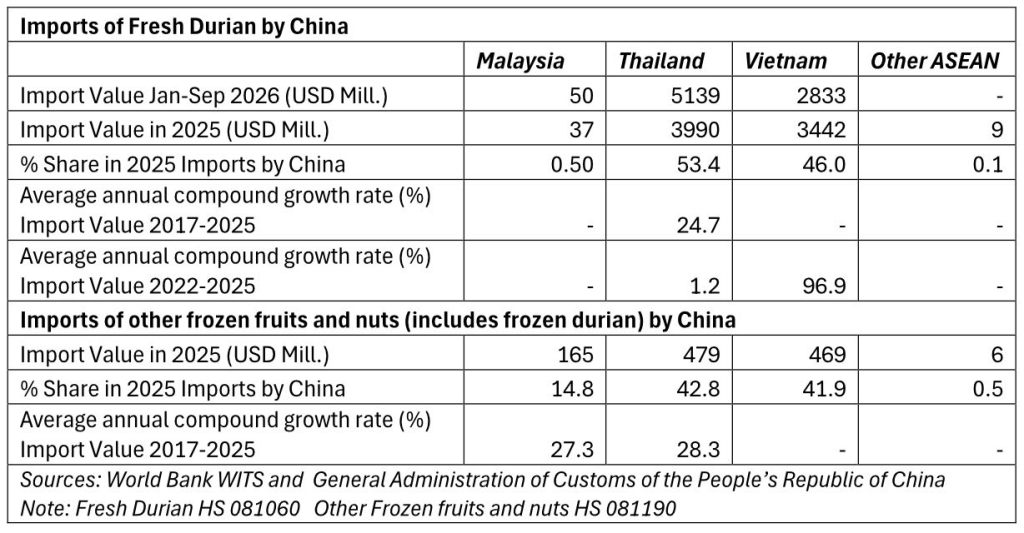
Durian has been in the news lately since there is now literally a ‘gold’ rush for the Chinese market. Thailand is the established incumbent in the Chinese market. It has been exporting durian to China since 2003 when it signed a free trade agreement with China which included zero tariffs on fruit and vegetables exported to China (Noodaeng). Malaysia has exported frozen durian pulp/pods to China since 2011, frozen whole fruit since 2019 and fresh durian since 2025. Vietnam has exported fresh durians since 2022 and frozen durian since 2025. Cryogenic freezing extends shelf life to roughly 18 weeks. As the table below shows, there is a preference for fresh durian in the Chinese market and Vietnamese exports have grown the fastest in recent years.
One of the first impacts of opening trade is that it affects the incentives of producers. In all countries producers are switching from other products to durian. In Thailand, from coffee, natural rubber and mangosteen (BigGo Finance). In Vietnam, from coffee. In Malaysia, jungles are being razed to produce durian (The Business Times). According to some estimates the revenues per hectare from durian are nine times those from oil palms (Suhana Safari). Durian production can provide EBIT (earnings before interest and taxes) margins in excess of 50%.
Thailand’s main cultivation area is Chanthaburi in Southern Thailand (between the Gulf of Thailand and Cambodia) and fresh durians are transported from Laem Chabang Port in refrigerated containers overland via road/rail to Vientiane (Laos), and on to Kunming on to the Laos-China railway (Xinhua & SCMP). They typically take three days to reach Kunming and another two days to Chengdu, Sichuan. Ocean freight is sent to Nansha port in Guangzhou and air cargo is used to ship to North-eastern Chinese provinces such as Shandong.
Thailand’s lead is being eroded by Vietnam in both volume and value, and it will have to compete with Malaysia on quality. The Thai government is relying on science to stay ahead (The Nation). Packing facilities are using AI to check for ripeness and to sort fruit (by weight) more accurately. Frequency-based technology is also being used to check for ripeness, calculate flesh weight and moisture content. The goal is to replace the traditional ‘knocking stick’ which is used in the industry today (CNA). X-rays and irradiation technology are being used to extend shelf life and to eliminate pests. Exports must meet the stringent Chinese SPS (Sanitary and Phytosanitary) standards which require cultivation areas to be free of heavy metals such as cadmium. The Thai food processing industry, like its neighbours in Malaysia, is also looking to develop new and innovative food and drink products. Present applications include durian puree, bakery products, ice cream, desserts, mochi, bubble tea, smoothies, fillings, sauces (The Straits Times).
Peninsular Malaysia is the main growing region in Malaysia although durian is also cultivated in Sabah and Sarawak (east Malaysia). Until recently since only frozen durian was exported to China, the main shipping route was from Port Klang to Nansha in Guangzhou. Jiangnan market in Guangzhou is the biggest market for imported fruit and serves the whole of China. According to some estimates (Suhana Safari) the journey from farm to retail takes roughly 28 days of which 12 are on the Malaysian side, and the remainder on the Chinese side, including 10-11 days in ocean-shipping. Tree-ripened fresh durian has to be sent by air cargo (40 tonnes a day presently). Some Malaysian companies are taking pre-orders only for fresh durian and promising delivery within 36 hours. How effectively Malaysia can compete at the high end of the market with Thailand depends on whether they are willing to harvest prior to ripening. Presently, the industry is not too keen as it believes that the distinctiveness of the product comes from it being ripened on the tree. At least for the time being this distinctiveness is allowing Malaysia to charge a premium price for its product.
China is the main export market for Vietnamese durian. Ri6 is the most popular variety. Vietnam has two main advantages over other competitors. The first is that it has a longer growing season since durian is grown in different regions. This allows it to supply well beyond the main seasons in Thailand and Malaysia which run roughly from April to August. The second is a supply chain advantage as it has a land border with China. Durians are shipped by road mainly through the Mong Cai – Dongxing (Guangxi) crossing, which is three hours away from the growing region and also via Ping Xiang (Guangxi). Vietnamese durian can be in Heilongjiang in North-eastern China in about 6 to 8 days (CNA). The main hurdle, other than uneven product quality, is adequate infrastructure to meet the SPS requirements. For now, Vietnam is a volume/mass market play. The government is working to improve traceability via the use of QR codes – there are almost 1600 registered growing area codes and about 280 packing company codes. In addition, it is working to standardize quality management and also building a network of testing labs to address food-safety-related issues (Amanda Lim).
In addition to impacting trade balances, exports also force domestic producers to ‘upgrade’ to meet international standards. The investments by government in food safety and freshness preservation in Thailand, and to a lesser extent in Vietnam are examples. These investments will have a spillover effect on exports of other fresh fruit and vegetables by these countries, not just to China but to other export markets as well.
Building infrastructure and improving connectivity can also have spillover effects. The construction of the Laos-China railway (BRI project) has led to an increase of 18% in Thailand’s border and transit trade in 2026. Shippers of durians and of other goods are switching from road to rail in Thailand. Cambodia is also benefiting from the China-Laos rail connectivity. Although it is a new and small entrant to the fresh durian market in China, volume of exports increased 40 times in the first six months of 2026, compared to the same period in the previous year. Cambodia has opened a new cross-border land transport corridor to China via Laos. This cuts delivery times from 15-20 days to 5 days (China Daily).
The Thai durian wholesale, packaging and logistics industry is attracting Chinese investment, according to some estimates, 70% is controlled by Chinese business (The Business Times).
There is some evidence of clustering on the Chinese side of the border. Processing plants are being set up in Pingxiang, China, near the Vietnam border. This creates jobs in that region and allows buyers access to fresher fruit and more variety. At the other major border crossing (Dongxing), fresh fruit traders are setting up facilities to help streamline customs clearance, product sorting, packaging and distribution throughout China (CNA). These facilities will benefit all Vietnamese exporters of fresh fruit and vegetables.
The gold rush has also changed incentives in the export market. In 2019 China started experimenting with domestic cultivation including of premium Malaysia and Thai varieties in Xishuangbanna (north of Laos) in Yunnan province and in Hainan province. Although first commercial harvests were achieved in Hainan in 2023 and in Yunnan in 2026, production is miniscule relative to imports of fresh durian (Xinhua). In the medium term the reliance on ASEAN will continue. The bigger challenge for ASEAN may be weather related harvest fluctuations.
On the innovation front, there is room for cooperation between China and ASEAN. They can cooperate in building a circular durian industry by finding uses for durian husks – which are going to become an issue in China as consumption increases. Efforts are already underway in Singapore, Malaysia and Thailand, which are exploring different potential applications from packaging and paper to skincare and medical applications.
Sources
Data: WITS-World Bank and General Administration of Customs, People’s Republic of China.
Image: Screen capture from BigGo FinanceScreen
BigGo Finance, 2026. “Thai Farmers Pile into Durian on China Demand Boom, Raising Oversupply Concerns.”
CNA Insider: As China and Vietnam Grow Closer, What Changes at the Border?
China Daily: Yan Hang, 2026. “Exporters of Durian Taste Sweet Success”.
Noodaeng, S., 2017. “Export Competitiveness of Thai Durian in China Market.”
Sean Wang Zi-Ming, 2026. “Disgust, Desire and Durian.”
Suhana Safari, et al., 2021. “From Farm to China: A case study of Malaysian frozen whole durian export supply chain.”
Amanda Lim, 2026. “From farm to border: Vietnam develops traceability system to secure future of durian exports”.
South China Morning Post, 2026. “Durian Express? New Southeast Asia rail service cuts fruit prices in China”.
The Business Times (Singapore), 2024. “China’s lust for durian in creating fortunes in South-east Asia”. Reprinted from the New York Times.
The Straits Times (Singapore), 2026. “Thailand turns to AI and science to upgrade durian export quality.”
The Nation, 2026. “Thailand turns to AI and science to upgrade durian export quality”.
VN Express International: Dat Nguyen, 2026. “Vietnam Durian Exports to China Soar”.
Xinhua, 2026. “China’s durian trial crop eyes market entry amid strong consumer appetite”.
Xinhua, 2026, “China’s durian boom is ripening into a regional supply-chain story.”


Leave a Reply