There is still time to switch the ASEAN agenda from petroleum to renewable energy
At the ASEAN Summit in Cebu President Marcos Jr. called on fellow ASEAN countries to ratify the ASEAN Petroleum Security Agreement (APSA) as soon as possible. The operational details of the agreement are yet to be worked out. The Philippines of course declared a national emergency in March, but even if APSA is ratified by November, it is unlikely to be of much use in the present crisis. This is system-wide shock; all countries have been impacted negatively at the same time and it is unlikely that anyone is going to have excess petroleum to contribute to a reserve or to share with neighbours. The present challenge is to prevent stock-outs. Rising prices will create inflation, but rising prices and stockouts will create stagflation.
Collective action sounds nice, but may not always work, or at least not for the common good. It did not work during the Covid-19 pandemic when wealthy nations hoarded vaccines. And the Philippines of all countries should recall that it was the target of a Pentagon propaganda campaign aimed at discrediting the vaccine made by Sinovac. Collective action also did not work when the Rogue Nation imposed tariffs on pretty much the rest of the world. Instead of coming together to collectively push back, countries were eager to cut favourable bilateral deals. Bongbong Marcos is barking up the wrong tree. But who can blame him? At the same time as the Cebu Summit, he was busy doing ‘bang-bang’ at Balikatan 2026 – that diesel could have been diverted to civilian use.
According to a recent IMF paper, the Philippines has “one of the lowest installed energy capacities in ASEAN” on both an absolute and per-capita basis. And it relies heavily on imported fossil fuels which accounted for 63% of power generation in 2024. Yet the Philippines has huge potential for the development of renewable energy. Solar and wind could provide 1,200 gigawatts; hydro, roughly 13 gigawatts and geothermal, about 4 gigawatts. The installed renewable energy capacity in 2024 was 9.5 gigawatts.
The report also indicates that the Philippines “receives a marginal share of public bilateral investments in renewable energy from within Asia”, or from countries such as China, Japan and Korea. It receives funds from Korea and Japan which lead public funding in geothermal energy. The bigger potential of the Philippines is in wind and solar, where China is the largest public investor in ASEAN.
What are the other hurdles? Access to finance and high capital costs, a deficit of skilled workers particularly technicians and associate professionals, land acquisition, and a transmission and distribution system with limited capacity and coverage. These are ‘development’ problems or ‘business environment’ problems.
And there are the ‘families’ as well, which are intertwined with politics. Historian Alfred McCoy described the problem as follows:
“Under the doctrine of national development, The Philippine state has accumulated substantial financial resources and broad regulatory authority. But, instead of using these economic powers to promote economic development, as in South Korea or Singapore, the Philippine executive branch has expended these resources as “rents” to reward retainers”.
McCoy was writing about Marcos Sr. but corruption continues to plague the government of Marcos Jr.
Lifting all boats
Instead of ASPA, Marcos should have focussed the agenda on renewable energy. Domestically it would have given him a ‘to-do list’ to improve the business environment. Improving the transmission infrastructure has society-wide benefits regardless of the extent of fossil fuel use in generation. Making land acquisition easier will help not just renewable energy projects, but business in general. Similarly, investing in skills, particularly those relevant for future industries makes sense, because there is an expectation that at least some BPO (business process outsourcing) activities will be disrupted by AI. Even those that remain may require a more skilled workforce.
The ASEAN summit in Cebu would have been an ideal platform to address the financing constraints, which could also be brought up at ASEAN+3 meetings. According to the IEA (International Energy Agency) ASEAN’s solar and wind potential is “more than 55 times its current generation capacity”. Harnessing this potential will decrease the cost of supply and improve energy security and resilience – what happens to the price and supply of oil will matter less. This is a good thing from a budgetary perspective as well, since some ASEAN countries provide general fuel subsidies or to targeted sectors such as agriculture and fisheries.
Discussing the ASEAN power grid is premature if individual members don’t make progress in their own energy transitions. In the first instance, domestic policy is more important. The IEA suggests that 27 billion USD is required by 2040 in inter-connector investment. The required investment in grids is even higher at 330 billion USD by 2040. ASEAN has already signed an MOU with the ADB and the World Bank to mobilize funds for inter-connection and domestic grid upgrades. What is missing is mobilizing private sector finance and this is what Marcos Jr. should have focussed on at Cebu.
He could have started domestically by engaging the ‘families’. According to Joe Studwell, the problem is not with oligarchs, but with what they do with their money. If the state is unable to co-opt them to spend on manufacturing and or economic development projects, they will spend it on real estate, building apartments, malls and five-star hotels, just as the Sy, Ayala, Villar, Gokongwei, Tan and Araneta families have done in Metro Manila.
The slow man of ASEAN or the sick man of ASEAN?
More productive investment, investment in future-ready skills and improving the business environment will help economic growth more than spending private money on real estate and public money on the military.
The Philippines went through an economic crisis and political instability in the mid-1980s. That’s when it picked up the label of being the ‘Sick Man of Asia’. The following table uses data from the World Bank (only available from 1990 onwards). Over the last 35 years, the Philippines was the second-worst performer after Brunei, in raising the standard of living of its people. Viet Nam, a latecomer to ASEAN and to the prosperity ladder, overtook the Philippines in 2003. If these trends persist, Lao may be the next one.
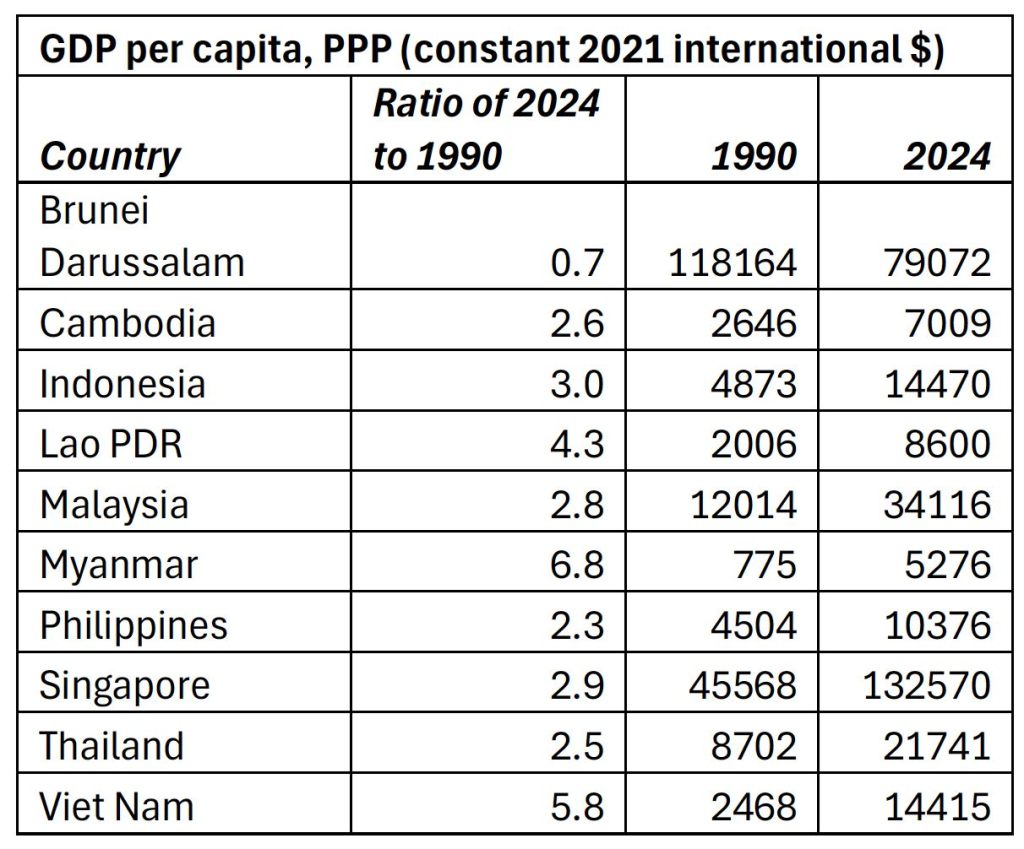
Who else overtook the Philippines? To answer that, one has to go back to 1960 and use PPP data from the Penn World Tables. The data show that in 1960, the average person in the Philippines had a higher standard of living than the average person in China, Indonesia, South Korea and Thailand. The average person in all those countries is now ahead.
There is still time for Marcos Jr. to switch the ASEAN agenda and pivot to renewable energy. And I am quite confident that Singapore will be happy to carry forward that agenda to 2027.
References
ASEAN Secretariat: ASEAN leaders’ statement on the response to the middle east crisis. May 8, 2026.
ASEAN Secretariat: ADB and World Bank Group Launch the ASEAN Power Grid Financing Initiative with the ASEAN Secretariat and the ASEAN Centre for Energy (ACE). October 25, 2025.
CNA Insider: Outsourcing Jobs in India and Philippines.
IEA: Accelerating Renewables Growth in ASEAN
IEA: Financing the ASEAN Power Grid
IMF 2026: Renewable Energy Transition in the Philippines
Alfred W. McCoy (ed.) (2009), “An Anarchy of Families: State and Family in the Philippines”, University of Wisconsin Press, Madison, (page 430).
Pentagon Antivaccine Propaganda
Straits Times: ‘There is a need for collective action’: Middle East Crisis dominates ASEAN Summit in Cebu. May 7,2026.
Joe Studwell (2013), “How Asia Works: Success and Failure in the World’s Most Dynamic Region”, Grove Press.


Leave a Reply