
According to the ASEAN secretariat, China has been ASEAN’s largest trading partner since 2009 and a decade later in 2019, ASEAN became China’s largest trading partner. In 2024, China accounted for about a fifth of ASEAN’s total (two-way) merchandise trade.
The relationship has continued to evolve, particularly since the pandemic in 2020, initially due to single-sourcing concerns of many countries; later due to the continuing geopolitical games being played by successive U.S. administrations; and more recently due to the coercive tariffs imposed by the Rogue Emperor and his unnecessary proxy wars and military adventures. And not to forget the stale but enduring narratives of ‘China Shock version n’; and most recently the ‘China squeeze’ (see The Straits Times and Chatterjee & Subramanian 2026).
ASEAN has no doubt been impacted by all of these in some way or another, but at the same time most ASEAN countries understand that China is their neighbour and they need to find ways not only to live peacefully with China but also to leverage China’s growth for their own economic transformation.
Singapore, Malaysia, Indonesia, Vietnam and Thailand are integrated into global value chains (GVCs) in varying degrees and in different sectors and a recent report by Bank Negara Malaysia indicates that Malaysia is sourcing more foreign inputs regionally. In 2022, more than half of foreign value added in Malaysia’s gross exports was drawn from Asia. Malaysia has deepened its integration in regional production networks and has a “rising dependence on China as a major source of intermediate inputs” particularly in the electrical and electronics (E&E) industry which accounts for the largest share of foreign value added in Malaysia’s gross exports. The E&E industry is also important from a domestic value added (DVA or local content in gross exports) perspective. Of all industries, the E&E industry registered the largest (11.6 percentage points) increase in DVA intensity (share of domestic value added in gross exports) between 2010 and 2022.
A recent study by the Donato & Kitsios (IMF) finds that ASEAN economies have increased their imports from China in the electrical machinery and electronics sector. They suggest that this does not indicate that ASEAN countries are ‘connecter economies’ as earlier asserted (for Vietnam and Mexico) by Gopinath and others (IMF). Gopinath observed that China’s exports to the US have declined but those from Mexico and Vietnam have increased; as have China’s exports (and direct investment) to Mexico and Vietnam. In other words, these countries are effectively conduits for Chinese (indirect) exports to the US.
Instead, Donato & Kitsios indicate that that there is an increased demand in ASEAN for intermediate inputs from China because ASEAN economies participate in GVCs. “ASEAN countries thus appear to have expanded domestic production and increased their share in global value added, while simultaneously reconfiguring their position in GVCs through higher foreign value added in exports”.
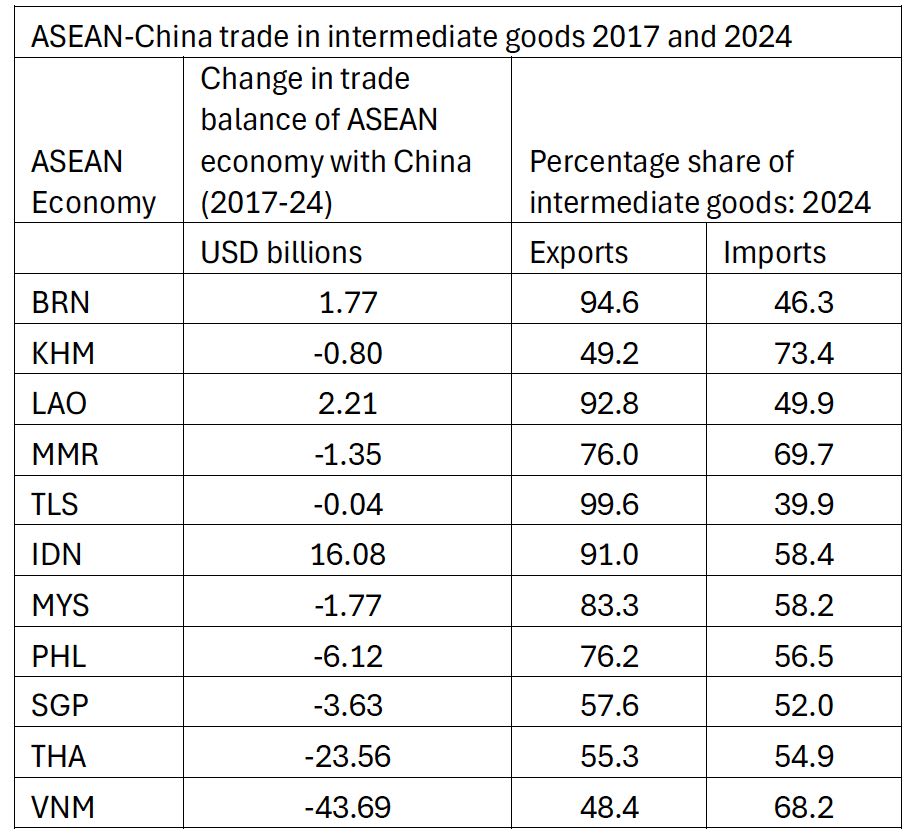
The following table shows that a significant portion of ASEAN’s trade with China is accounted for by intermediate goods (see notes for details/definitions).
I use 6-digit trade data to construct trade weighted complexity of intermediate goods traded between individual ASEAN economies and China in 2017 and 2024. This will help us understand how integration between ASEAN and China has evolved. In this exercise, the product complexity index is held constant at its 2024 value, so any changes between 2017 and 2024 are driven solely by changes in the composition of trade which could change due to changes in quantities and/or changes in prices. The table below provides the results of this exercise.
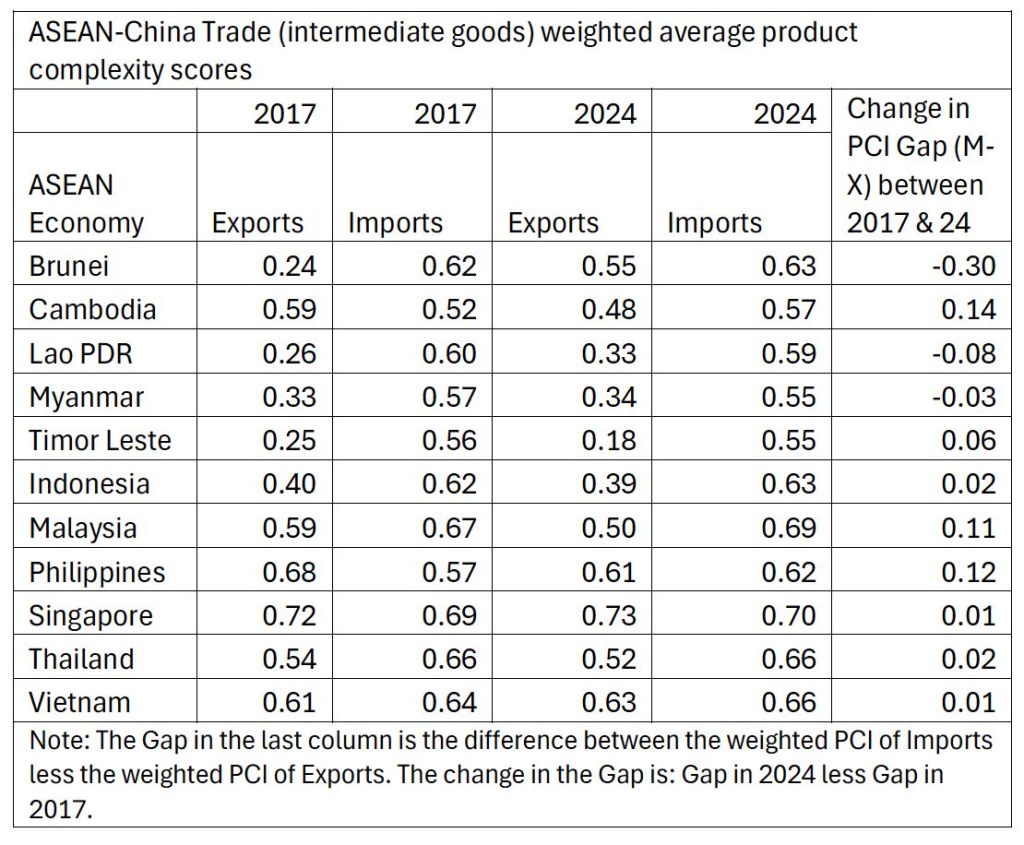
Comparing levels, the complexity of imports exceeds that of exports for eight of eleven ASEAN economies in 2017 and for all ASEAN economies except Singapore in 2024. In general, therefore, ASEAN imports more complex intermediate goods from China (or China’s exports to ASEAN) than it exports to China. The change in the PCI gap shows that the complexity gap (imports – exports) decreased for Brunei, Lao PDR and Myanmar and increased for the remaining ASEAN economies.
I explore Cambodia, Malaysia and the Philippines further since they show the highest increase in the gap. Decomposing this change involves examining the changes in the composition of trade at the product level, to identify the top (bottom) products driving the results.
Cambodia: Asymmetric China-linked integration
The decline in Cambodia’s export complexity is mainly explained by the total exit of optical apparatus parts (HS 900190), which collapsed from 18.8% of intermediate exports in 2017 to 0% in 2024. While Cambodia shows minor export gains in basic wire harnesses and telephone parts, its export expansion is primarily resource-driven, concentrated in copper matte, unwrought aluminium, and building stone (granite/marble).
In contrast, Cambodia’s intermediate imports from China became more sophisticated, dominated by photovoltaic/LED devices, semiconductor materials, coated textiles, and electrical conductors. Cambodia relies heavily on Chinese technical and textile inputs for local processing, while its intermediate export base remains firmly anchored in raw minerals and low-complexity assembly.
The Philippines: Asymmetric Dependence in Electronics and Resource Redux
The Philippines exhibits what may be described as a structural reversal. Within electronics, Philippine export shares fell across high-PCI categories, including processors and controllers (-0.034 contribution change, memory ICs (-0.020), amplifiers (-0.011) and other ICs (-0.010). Conversely, Philippine intermediate imports from China became heavily weighted toward high-complexity electronic components, led by other ICs (+0.059 contribution change), printed circuits (+0.015), photosensitive/LED devices (+0.011), and phone parts (+0.008).
At the same time, Philippine export gains to China were primarily concentrated in resource sectors – specifically copper ores, coal, and lignite -rather than manufactured inputs. The Philippine case thus demonstrates a dual structural transition: increasing upstream technical reliance on Chinese electronic components coupled with a commodity export pivot.
Malaysia: Restructuring within an advanced production network
Malaysia provides perhaps the clearest example of why aggregate trade balances can be misleading. Its intermediate export complexity falls substantially between 2017 and 2024, but much of the decline is associated with a reduced share of highly complex semiconductor products – not with an exit from electronics. This pattern conforms to the observations of Bank Negara Malaysia cited earlier.
The share of processors/controllers (HS 854231) in intermediate exports falls from 29.9% to 20.8%. That alone reduces export PCI by about 0.069. other semiconductor exports also fell including ICs, photovoltaic/LED components, parts, etc. At the same time imports from China became more concentrated in semiconductor components especially IC memory (contribution +0.046) and other ICs (+0.040).
Malaysia is simultaneously gaining share in solid-state storage exports; it is not exiting semiconductors, just recomposing within them possibly towards more back-end specialization. Other lower-complexity exports which gained export share include petroleum gases and pulp & paper products.
Recent media reports indicate that there is a “fresh” semiconductor boom in Penang due to AI and a medtech boom in Penang and in Malaysia more generally (>300 firms). Medtech is riding on the existing semiconductor cluster as it is “tapping many of the same engineering skills, precision manufacturing capabilities and supplier networks that helped establish it (Penang) as a semiconductor hub”.
The economic diversity of ASEAN economies suggests a more nuanced story, rather than broad-brush narratives about a linear ladder or sequence of development; or whether the Chinese geese are flying or not. Media reports indicate that apparently, they were in 2024 (Business Times) but are not in 2026 (Straits Times).
In 2019 relocation of production was “concentrated in electronics and apparel”. Now (in 2024) it appears to be more board-based across automobiles, electronics, apparel, capital goods, consumer durables and the semiconductor sector.” In 2019 the shift was led by US companies and those from Taiwan (China) and Japan. In 2024, China was the main investor with investments concentrated in ASEAN (rather than in Mexico and India). Vietnam is identified as the main beneficiary in sectors including electric vehicles(EVs), personal computers and solar panels; Malaysia in semiconductor assembly and testing; electronics and data centers; Thailand in EVs, printed circuit boards and consumer durables; Indonesia in EV batteries; “while the Philippines has lagged”.
In 2026 “China has broken the “flying geese” model and, with it, Asia’s traditional route to prosperity. Why? “China won’t leave low-tech” – it is still making both low-end (labour intensive) and high-end even though its wages have gone up. Conclude: Western, Japanese, Korean etc. geese ‘good’. Chinese geese ‘bad’.
To add to confusion an earlier paper (Chatterjee and Subramanian 2020) shows that when China does lose export market share, some of it is picked up by the Europeans: Do they have low wages? Why are they preventing Asia from developing? They write “China is currently vacating the low-skill export space … the table shows that post-GFC (Global Financial Crisis), China vacated about $140 billion in exports in unskilled-labour intensive sectors, including apparel, clothing, leather and footwear.” They go on to lament that India has not taken advantage of this “very real” opportunity. If not India, then who did? Their data (Table 4 in the paper) show that China lost 7.5% global market share in footwear, 5.8% in apparel and 3.4% in leather. The top 3 gainers were as follows:
Footwear: Vietnam (5.9%), Germany (1.4%), Belgium (0.7%).
Apparel: Vietnam (2.9%), Bangladesh (2.8%), Spain (0.7%).
Leather: Vietnam (2.5%), Italy (1.6%), France (1.5%).
In 2026, the same authors write about the ‘China squeeze’ where they claim that despite rising wages and moving up the technology ladder China has “a historically unusual share of global low skilled manufacturing export markets” and it is compressing “the industrialization space poorer economies need in labour-intensive manufacturing”. By poorer economies they mean low and middle-income countries.
Now return to their data and ask why was China vacating the low-skill space in 2020 but not in 2026? And why was the space it was vacating in 2020 being partially occupied by European countries (this likely represents quality segments)? Excuse me – this space is meant for low-wage poorer economies? Perhaps the more important question is: Why is Vietnam appropriating the major share of all the opportunities? I do not know about you – but in plain Singlish – I so confuse Lah!
Gugu – will you fly?
Gugu’s story is my favourite China goose story. His owner Ms. Wu was moving from Shanghai and wanted someone to adopt him. She wrote on Weibo asking Shanghai Maritime University to take him as they already had a gaggle of geese on campus. The University sent Gugu an admission letter to the Intelligent Lake Ecology Department.
I am guessing Gugu will fly at some point, but not before he has upgraded his skills. Will he fly from Shanghai to a western Chinese province (which has a lower wages and per-capita income than the coastal provinces and is seeking to upgrade its economy by attracting new geese) or further to Lao or Cambodia?
That depends on which location allows him to be more productive. In other words, it depends on the business environment at these different locations. Gugu may never fly if he can be most productive by remaining in Shanghai. China has a much larger population (domestic market) than Japan, South Korea etc., so Chinese geese (skilled or unskilled) are not a hurry to leave if they can be more profitable at home.
Wages are not the only determinant of relative attractiveness of a location and I suspect textile workers in China are not being paid Shanghai wages since they are probably migrants from rural areas. And it is possible they are more productive than textile workers in other locations. Labour productivity is only one source of advantage, China has others, like low energy costs, deep and efficient clusters, efficient logistics and what is called ‘China Speed’.
So better to forget about whether Gugu is flying or not and focus on improving your own business environment. This way, if and when Gugu flies, you can increase the likelihood of him flying to your province or country.
Notes
I use 6-digit BACI (balanced trade) data HS 2017. I use the OECD-BTiGE conversion key to identify intermediate goods.
To make the PCI I start with the countries and products listed in the OEC list and add those products which are on my list of intermediate products but not on the OEC list. My final list for calculating PCI includes 132 countries and 5042 products. I use the 2024 PCI values.
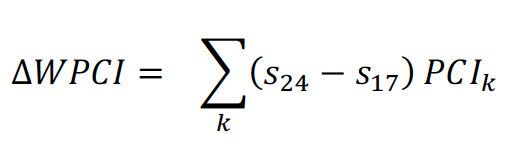
Since PCI is held constant, the decomposition of the trade-weighted PCI depends on changes in export/import shares summed over all intermediate goods (k) as shown below.
Sources
Bank Negara Malaysia Economic and Monetary Review 2025
S. Chatterjee S. and A. Subramanian (2020) India’s Inward (Re)Turn: Is it Warranted? Will it Work?
S. Chatterjee S. and A. Subramanian (2026) China’s mercantilist squeeze on developing countries.
IMF: G. Donatos and E. Kitsios (2026) ASEAN’s Trade and Investment in a Fragmented World, IMF Working Paper WP/26/118.
IMF: G. Gopinath et. al. (2024) Changing Global Linkages: A New Cold War? IMF Working Paper WP/24/76.
The Observatory of Economic Complexity (OEC)
OECD: Bilateral Trade in Goods by Industry and End-use Category (BTiGE) – Conversion Key.
Media Sources
The Business Times, Singapore (August 11, 2026) Penang looks beyond chips with a bigger medtech push.
The Business Times, Singapore (June 4, 2024) Asia’s new flying geese.
The Straits Times, Singapore (July 30, 2026) China has closed Asia’s path to industrialisation.
The Straits Times, Singapore (August 28, 2026) The geese stop flying: Why some Asian nations can’t take off.
The Straits Times, Singapore (August 16, 2018) Goose named Gugu admitted to Chinese university, thanks to owner’s passionate appeal.
Image
Screen Capture from the Stratis Times, Singapore (2018). Original from Weibo – Shanghai Maritime University.


Leave a Reply